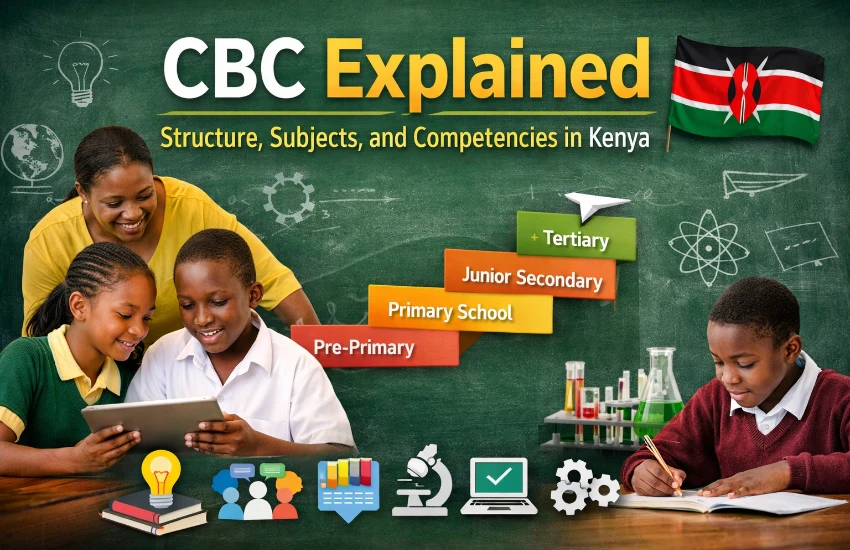
CBC Explained: Structure, Subjects, and Competencies in Kenya
Kenya’s education system has shifted from the 8-4-4 model to the Competency-Based Curriculum (CBC). This change affects how students learn, how teachers teach, and how parents support education at home. If you are a teacher, student, or parent, you need a clear understanding of how CBC works in practice, not just in theory.
CBC focuses on what learners can do with what they learn. It moves away from memorizing content for exams and puts more weight on skills, application, and continuous assessment. This shift raises a simple question for you: are you preparing learners to pass exams or to apply knowledge in real life?
How the CBC Structure Works
CBC follows a 2-6-3-3-3 structure. Each stage builds specific competencies and prepares learners for the next level.
- Pre-Primary (2 years): PP1 and PP2
- Primary School (6 years): Grade 1 to Grade 6
- Junior Secondary (3 years): Grade 7 to Grade 9
- Senior Secondary (3 years): Grade 10 to Grade 12
- Tertiary Education (minimum 3 years)
At the early levels, learning focuses on basic skills such as communication, numeracy, and social interaction. As learners move to Junior Secondary, subjects become more defined and structured. By Senior Secondary, students choose pathways based on their strengths and interests.
The Kenya Institute of Curriculum Development (KICD) outlines this structure in detail:
https://kicd.ac.ke/cbc/
If you are a teacher, think about your current lesson delivery. Does it build progressively from simple to complex skills? Or does it jump straight into content without context?
Learning Areas and Subjects in CBC
CBC organizes subjects into learning areas that match a learner’s development stage. The goal is to keep learning relevant and practical.
In lower primary, subjects are grouped to reduce overload and encourage integration. For example, Environmental Activities combines science and social studies concepts.
As learners progress, subjects become more distinct.
Key Learning Areas Across Levels
Lower Primary (Grades 1–3):
- Literacy Activities
- Kiswahili Language Activities
- English Language Activities
- Mathematical Activities
- Environmental Activities
- Hygiene and Nutrition
- Religious Education
- Creative Activities
Upper Primary (Grades 4–6):
- English
- Kiswahili or Kenyan Sign Language
- Mathematics
- Science and Technology
- Social Studies
- Religious Education
- Creative Arts
- Physical and Health Education
Junior Secondary (Grades 7–9):
- Mathematics
- English
- Kiswahili
- Integrated Science
- Health Education
- Pre-Technical Studies
- Social Studies
- Religious Education
- Business Studies
- Agriculture
- Life Skills Education
At Senior Secondary, students select one of three pathways:
- Arts and Sports Science
- Social Sciences
- Science, Technology, Engineering, and Mathematics (STEM)
This structure forces a practical decision early. What are you good at? What do you want to pursue? Many students struggle here because they are used to being told what to study instead of choosing.
Core Competencies in CBC
CBC is built around seven core competencies. These are the skills every learner should develop across all subjects.
- Communication and collaboration
- Critical thinking and problem solving
- Creativity and imagination
- Citizenship
- Digital literacy
- Learning to learn
- Self-efficacy
These competencies are not taught as separate subjects. Teachers are expected to integrate them into everyday lessons.
For example, a science lesson should not only teach facts. It should encourage students to ask questions, test ideas, and work in groups. A business studies lesson should go beyond theory and include practical problem-solving.
This approach aligns with global education trends. According to UNESCO, competency-based education improves learner engagement and real-world readiness:
https://www.unesco.org/en/education
If you are teaching, ask yourself this: Are your students actively participating, or are they just listening and taking notes?
Assessment in CBC
CBC replaces the heavy reliance on final exams with continuous assessment. Learners are evaluated over time through class activities, projects, and practical tasks.
Assessment is divided into:
- School-Based Assessment (SBA)
- National Assessments at key stages
This means performance is tracked consistently, not just at the end of a term or year.
For teachers, this increases workload. You must prepare tasks, observe learners, and record progress. For students, it reduces pressure from one final exam but demands consistent effort.
For parents, it changes how you measure progress. You can no longer rely only on report cards. You need to look at skills, participation, and overall development.
Challenges You Should Be Aware Of
CBC has clear goals, but implementation has faced challenges in Kenya.
Many schools struggle with:
- Limited teaching resources
- Large class sizes
- Inadequate teacher training
- Lack of digital infrastructure
A report by the Kenya National Bureau of Statistics shows gaps in resource distribution across schools:
https://www.knbs.or.ke/
These challenges affect how well CBC works on the ground. A well-designed curriculum does not guarantee effective learning if the environment cannot support it.
What CBC Means for You
CBC is not just a policy change. It directly affects how you approach education.
If you are a teacher, your role shifts from delivering content to guiding learning. You need to design lessons that engage students and build competencies.
If you are a student, you need to take more responsibility for your learning. You cannot rely on cramming before exams. You must stay consistent.
If you are a parent, you need to be more involved. You should understand what your child is learning and support them beyond homework.
Ask yourself:
- Do you understand the competencies your child is supposed to develop?
- Are you tracking skills or just marks?
- Are your teaching methods aligned with CBC expectations?
The Bigger Picture
CBC aims to prepare learners for real-world challenges. It focuses on skills that go beyond academics, such as problem-solving, creativity, and collaboration.
The success of this system depends on how well it is applied at the classroom level. A well-structured curriculum is only effective when teachers, students, and parents understand their roles and act on them.
The shift may feel demanding, but it also creates an opportunity to improve how education works in Kenya. The question is whether you are adapting to it or still holding on to old methods.