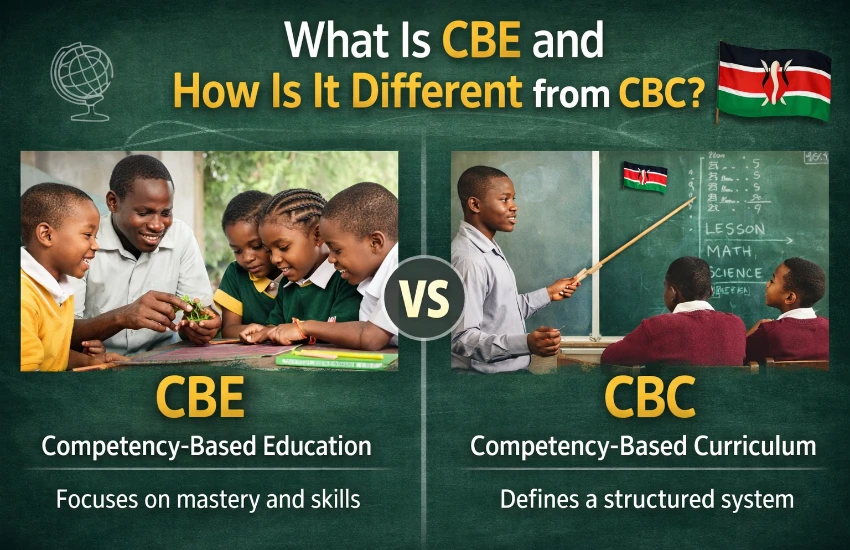
What Is CBE and How Is It Different from CBC?
You have probably seen both terms used in education discussions in Kenya: CBE and CBC. Many people treat them as the same thing, but they are not. If you are a teacher, parent, or student, this distinction affects how you plan, teach, revise, and even choose learning materials.
CBE stands for Competency-Based Education. CBC stands for Competency-Based Curriculum. One is an approach to learning. The other is the structured system Kenya uses to apply that approach. If you mix them up, you risk misunderstanding how learning is supposed to happen.
What CBE Actually Means
Competency-Based Education focuses on what a learner can do after learning something. It shifts attention from covering content to building skills that can be applied in real situations.
In a CBE system, progress depends on mastery. A learner moves forward after showing they understand and can apply a concept. This is different from moving forward because the term has ended or exams are done.
For example, in mathematics, a student should not just solve equations from memory. They should understand how to apply those equations in real-life situations like budgeting or measurements. If they cannot do that, then learning is incomplete.
According to UNESCO, competency-based approaches help learners develop practical skills needed in real life:
https://www.unesco.org/en/education
If you are teaching or studying, ask yourself this: Can you apply what you learn outside the classroom?
What CBC Means in Kenya
CBC is Kenya’s official education system. It is the structure that applies CBE principles across all levels of learning.
It defines:
- What learners study
- How they are assessed
- Which competencies they should develop
- How they progress from one level to another
CBC follows the 2-6-3-3-3 structure, starting from Pre-Primary up to tertiary education. It also defines subjects, learning areas, and assessment methods.
The Kenya Institute of Curriculum Development provides detailed guidelines on CBC:
https://kicd.ac.ke/cbc/
So while CBE is the philosophy, CBC is the system built around that philosophy in Kenya.
The Key Difference Between CBE and CBC
The simplest way to understand the difference is this:
- CBE is the approach
- CBC is the implementation
CBE can exist without CBC. Many countries apply competency-based education in different ways. CBC is Kenya’s specific version of applying CBE.
Here is a clear comparison:
- CBE focuses on learning outcomes
CBC defines how those outcomes are taught and assessed - CBE is flexible and general
CBC is structured and specific to Kenya - CBE can apply in any education system
CBC applies only within Kenya’s education system - CBE emphasizes mastery and skill application
CBC organizes subjects, levels, and assessments around that goal
If you are developing lesson plans or revision materials, this difference matters. You are not just following CBC guidelines. You are also expected to apply CBE principles in how you teach.
How This Difference Affects Teaching
If you are a teacher, CBC gives you the structure, but CBE guides how you deliver content.
For example, you may have a lesson plan from Elimu Centre under the Lesson Plans category. The structure is already aligned with CBC. It shows what to teach and when.
But how you teach that lesson determines whether you follow CBE.
Do you:
- Ask students to solve real problems?
- Encourage discussion and collaboration?
- Assess understanding through activities, not just tests?
Or do you:
- Explain everything while students listen?
- Focus only on finishing the syllabus?
- Test memory instead of understanding?
The first approach reflects CBE. The second one does not, even if you are using CBC materials.
How This Difference Affects Students
If you are a student, CBC defines what you study. CBE defines how you should approach learning.
You cannot rely on memorizing Notes and hoping to pass Exams. You need to understand and apply concepts.
For example, using Topical Revision Booklets from Elimu Centre can help you practice specific areas. But if you only memorize answers without understanding patterns, you will struggle in real assessments.
A student preparing for KCSE Revisions should focus on:
- Understanding concepts
- Practicing application
- Reviewing mistakes
Not just repeating answers.
Ask yourself: when you revise, are you preparing to answer questions or to solve problems?
How This Difference Affects Parents
Parents often focus on grades. CBC requires you to look beyond marks and understand competencies.
A child may score average marks but show strong skills in communication, creativity, or problem-solving. These are part of CBE.
If you support your child using resources like Holiday Assignments or Records of Work from Elimu Centre, you should also track how well they:
- Apply knowledge
- Work independently
- Improve over time
You need to shift from asking “What did you score?†to “What did you learn and apply?â€
Practical Example: CBE vs CBC in Action
Take a simple topic like agriculture in Junior Secondary.
Under CBC, the curriculum will define:
- The topic
- The objectives
- The assessment method
Under CBE, the focus shifts to what the learner can do.
Instead of just learning types of crops, a learner may:
- Identify crops in their environment
- Explain how to grow them
- Apply the knowledge in a small project
This is where Schemes Of Work and Lesson Plans must align with real activities, not just theory.
Where Elimu Centre Fits In
Platforms like Elimu Centre play a key role in bridging the gap between the CBC structure and the CBE practice.
You can access:
- Schemes Of Work to plan your teaching
- Lesson Plans to structure lessons
- Notes to guide content delivery
- Exams to assess learners
- Topical Revision Booklets for focused practice
- CBE Curriculum Designs for competency alignment
But the real value depends on how you use these materials.
Do you adapt them to fit your learners? Or do you follow them without thinking about outcomes?
The Bigger Question You Should Ask
Understanding the difference between CBE and CBC is not just about definitions. It affects how you approach education every day.
If you are a teacher, are your lessons building skills or just covering content?
If you are a student, are you learning to apply knowledge or just preparing for exams?
If you are a parent, are you tracking competencies or only marks?
The shift to CBC was meant to improve how learners prepare for real life. That goal depends on whether CBE is actually applied in classrooms, not just written in policy documents.