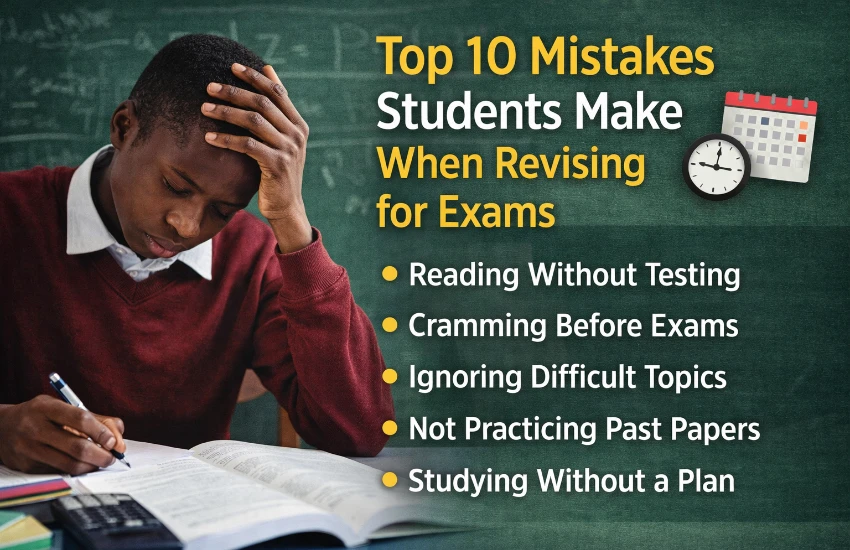
Top 10 Mistakes Students Make When Revising for Exams
Most students believe they are revising, but in reality, they are just going through content. This is why many put in long hours and still get average results. Revision is not about time spent. It is about how you engage with what you study.
If your current approach is not improving your performance, you need to question it. Are you revising actively or just reading? Are you testing yourself or avoiding difficult areas? These questions matter more than the number of hours you study.
1. Reading Without Testing Yourself
Many students spend hours reading Notes and feel productive. The problem is simple. Reading alone does not prove understanding.
If you cannot recall information without looking, you have not learned it. This is why students who “covered everything†still struggle in Exams.
A better approach is to test yourself after every topic. Use past questions or Topical Revision Booklets to check your understanding. If you fail, that is useful feedback, not failure.
Ask yourself: can you explain the topic without looking at your notes?
2. Cramming Instead of Spacing Revision
Cramming the night before an exam may help you remember facts for a short time, but it does not build lasting understanding.
Research shows that spaced repetition improves long-term memory.
If you are preparing for KCSE Revisions, you need a plan that spreads topics over weeks or months. Short, consistent sessions work better than long, irregular ones.
Do you have a revision timetable, or are you studying randomly?
3. Avoiding Difficult Topics
It is easy to focus on what you already understand. It feels productive, but it creates gaps in your knowledge.
Exams often test the areas you avoid. Ignoring difficult topics does not make them disappear.
You should identify weak areas early and spend more time on them. Use targeted resources like Topical Revision Booklets to focus on specific topics instead of revising everything at once.
What topic are you avoiding right now?
4. Relying Too Much on Notes
Notes are useful, but they should not be your main revision tool. Many students keep rereading Notes without applying the content.
Real exams test application, not just recall. You need to practice answering questions.
Platforms like Elimu Centre provide both Notes and Exams. The difference is how you use them. Notes help you understand. Exams help you apply.
If you spend 80 percent of your time reading and only 20 percent practicing, you are preparing the wrong way.
5. Not Practicing Past Papers
Past papers are one of the most effective revision tools, yet many students ignore them until the last minute.
Past Exams show you:
- Question patterns
- Common topics
- How answers are structured
If you are serious about improving, you should practice past papers regularly. Do not just read them. Attempt them under exam conditions.
Are you familiar with how questions are set, or are you guessing what will come?
6. Studying Without a Plan
Some students sit down to revise without a clear plan. They pick topics randomly and stop when they feel tired.
This approach leads to uneven coverage. Some topics get too much attention, while others are ignored.
You need a simple plan that answers:
- What will you study today?
- How long will you study?
- What outcome do you expect?
Even a basic weekly timetable can improve your focus. Without a plan, revision becomes guesswork.
7. Passive Group Discussions
Group discussions can help, but only if they are structured. Many students join group discussions that turn into social sessions.
You may spend hours discussing topics without actually learning anything.
If you choose to study in a group, set clear goals. Focus on specific questions or topics. Challenge each other.
Ask yourself: Does your study group improve your understanding, or does it waste your time?
8. Ignoring Feedback
When you attempt questions and get them wrong, that is where learning happens. Many students ignore corrections and move on.
This is a mistake. If you do not understand why an answer is wrong, you will repeat the same error.
Use marking schemes and Records of Work to track your mistakes. Review them regularly.
Do you keep track of your weak areas, or do you forget them after each test?
9. Studying for Too Long Without Breaks
Long study sessions reduce focus. After a certain point, your brain stops absorbing information.
Short, focused sessions with breaks are more effective. For example, study for 50 minutes, then take a short break.
This approach keeps your mind active and improves retention.
If you feel tired but keep pushing, are you really learning anything?
10. Ignoring Practical Application
Many students focus only on theory. This is a problem, especially under CBC, where application matters.
You need to connect what you learn to real situations. For example:
- In science, think about real-life experiments
- In business studies, relate concepts to actual businesses
- In agriculture, connect topics to what you see around you
Using resources like CBE Curriculum Designs from Elimu Centre can help you align your revision with competency-based expectations.
Can you apply what you study, or do you only recognize it on paper?
A Better Way to Approach Revision
If you want to improve your results, you need to change how you revise. Focus on understanding, application, and consistency.
A practical revision approach should include:
- Reading Notes to understand concepts
- Practicing with Exams and past papers
- Using Topical Revision Booklets for weak areas
- Reviewing mistakes regularly
- Following a clear timetable
Elimu Centre provides these resources in one place, but the outcome depends on how you use them.
You do not need more materials. You need a better strategy.
Think about your current revision habits. Which of these mistakes are you making? And what will you change before your next exam?